$29 Emergency Exam - Walk-Ins Welcome - Same-Day Dental Appointments Available

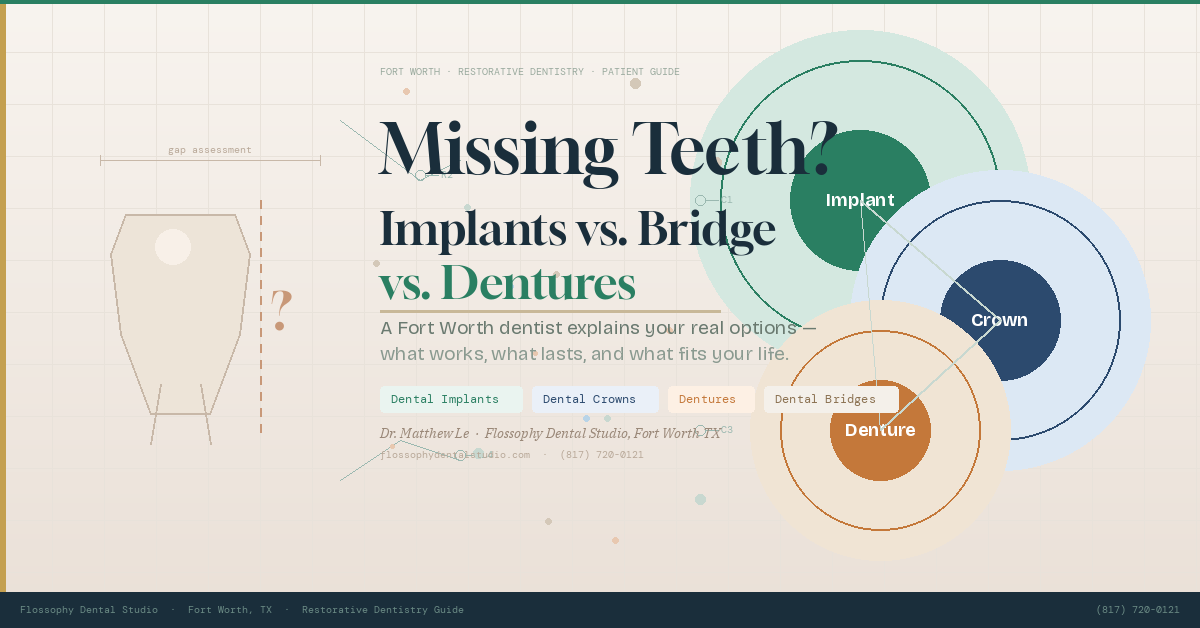
I’m Missing Multiple Teeth — Do I Need Implants, a Bridge, or Dentures? A Fort Worth Dentist Explains
If you are missing one or more teeth, you have probably heard three words more than any others: implant, bridge, denture. Maybe your dentist mentioned all three in the same appointment. Maybe you have been Googling at midnight trying to figure out which one makes sense for your situation.
It is a genuinely confusing decision — and it is one that has real, long-term consequences for your health, your appearance, and your wallet. The right choice for one person can be completely wrong for another, even if they are missing the exact same teeth.
Dr. Matthew Le at Flossophy Dental Studio in Fort Worth walks through this decision with patients every single week. This guide covers everything he explains in those conversations — so you can walk into your consultation already informed.
Why Missing Teeth Is Not Just a Cosmetic Problem
Before comparing treatment options, it helps to understand why missing teeth need to be addressed at all. Many people think of a gap as purely a cosmetic concern — something that affects their smile but not their health. That is not accurate.
When a tooth is lost, the bone underneath it no longer receives stimulation from chewing. Without that stimulation, the jawbone begins to shrink — a process called bone resorption. This happens faster than most people expect: measurable bone loss can occur within the first year after tooth loss.
- Neighboring teeth gradually drift or tilt into the gap, misaligning your bite
- The tooth directly above or below the gap can begin to over-erupt
- Jawbone loss changes the shape of your face over time — particularly the lower third
- Chewing efficiency drops, affecting digestion and nutrition
- Speech can be affected, particularly with front tooth loss
💡 Important: The longer you wait to address missing teeth, the fewer options you may have. Significant bone loss can make dental implants impossible without additional bone grafting — which adds cost and time to treatment. Acting sooner almost always means more options and simpler treatment.
The Three Main Options: A Plain-English Overview
Let’s look at each option honestly — not just the marketing version, but what they actually involve, what they cost, and who they are actually right for.
Option 1
Dental Implants
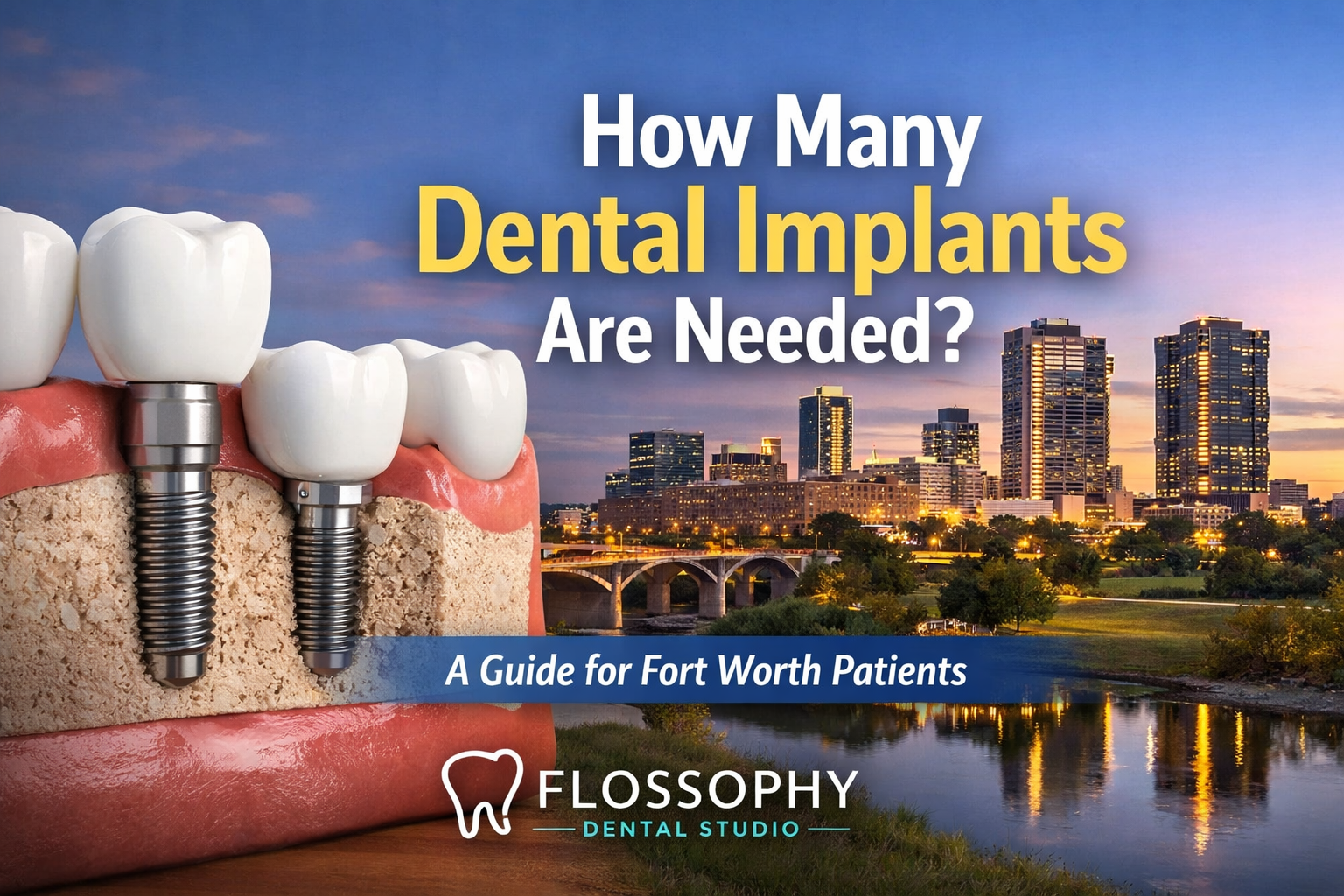
A dental implant is a titanium post that is surgically placed into the jawbone, where it fuses with the bone over several months. Once healed, a dental crown is attached to the top of the post — creating a replacement tooth that looks, feels, and functions like a natural tooth.
Implants are the only tooth replacement option that actually replaces the root of the missing tooth, not just the visible crown. This is what allows implants to stop — and in some cases reverse — jawbone loss.
Typical timeline: 3–6 months for osseointegration (bone fusion) + crown placement. May require bone grafting first if significant bone loss has already occurred.
✅ Best for
Patients with one or several missing teeth, good jawbone density, non-smokers, patients who want the most natural long-term result and are willing to invest upfront.
⚠ Consider carefully if
You smoke heavily, have uncontrolled diabetes, significant bone loss already, or need a faster solution. Not suitable for growing children/teens.
Option 2
Dental Crowns (as part of a Bridge)
A dental crown on its own restores a single damaged or weakened tooth by capping it. But when teeth are missing, crowns are most often used as part of a dental bridge — a structure that spans the gap left by one or more missing teeth.
A traditional bridge works by placing crowns on the healthy teeth on either side of the gap (called “abutment teeth”), with an artificial tooth — called a pontic — suspended between them. The bridge is cemented in place and is not removable.
Typical timeline: 2–3 weeks from preparation to final placement. Much faster than implants. No surgery required.
✅ Best for
Patients missing one to three consecutive teeth, patients who prefer no surgery, patients who need faster results, and patients where the neighboring teeth already need crowns.
⚠ Consider carefully if
The neighboring teeth are perfectly healthy (a bridge requires shaving them down). Does not stop bone loss under the gap. Bridges typically need replacement after 10–15 years.
Option 3
Dentures
Modern dentures have come a long way from the uncomfortable, ill-fitting appliances of previous generations. Today’s dentures are custom-crafted to fit the unique contours of your mouth and look natural. They come in two main forms: complete dentures (replacing all teeth on the upper or lower arch) and partial dentures (replacing several missing teeth while preserving remaining natural teeth).
Dentures rest on the gum tissue and, in the case of upper dentures, are held in place partly by suction. They are removable and must be cleaned daily outside the mouth. Implant-supported dentures (also called snap-in dentures) use implant posts as anchors, dramatically improving stability and comfort.
Typical timeline: Several appointments over 4–8 weeks for custom fabrication and fitting adjustments.
✅ Best for
Patients missing most or all teeth, patients needing the most affordable complete-arch solution, older patients where extensive implant surgery is not ideal, or as a transition while implants heal.
⚠ Consider carefully if
You are missing only one or two teeth (a bridge or implant is usually better). Traditional dentures continue to allow bone loss. Require daily removal and cleaning routine.
Side-by-Side Comparison
Here is the information that most patients actually need to make this decision:
| Factor | Implant | Bridge (Crown) | Denture |
|---|---|---|---|
| Stops bone loss? | Yes — only option | No | No (unless implant-supported) |
| Surgery required? | Yes | No | No |
| Timeline | 3–6 months | 2–3 weeks | 4–8 weeks |
| Affects neighboring teeth? | No — stands alone | Yes — crowns required on adjacent teeth | Partial dentures use clasps on adjacent teeth |
| Removable? | No — permanent | No — cemented | Yes — removed nightly |
| Lifespan | 20–30+ years (with care) | 10–15 years | 5–10 years before relining |
| Feels most natural? | Yes — closest to natural teeth | Very good | Good, but takes adjustment |
| Cost (approximate) | Higher upfront | Moderate | Most affordable upfront |
| Insurance coverage | Partial or none | Often partially covered | Often partially covered |
| Best for # missing teeth | 1 to full arch (All-on-4) | 1–3 consecutive teeth | Several to all teeth |
What About When You Need All Three?
This is where the concept of full mouth reconstruction comes in — and it is something Dr. Le sees regularly at our Fort Worth dental office.
Some patients come in with a combination of severely damaged teeth, missing teeth, and weakened structures throughout their mouth. In these cases, no single treatment solves everything. A full mouth reconstruction creates a comprehensive plan that may use implants in some areas, crowns to restore damaged teeth in others, and dentures or bridges where appropriate — all working together to rebuild a functional, healthy, natural-looking smile.
Most patients think they need to pick one option — implant or bridge or denture. But for many people who come to us, the best result comes from combining them strategically. An implant here to anchor, crowns there to restore, maybe a partial denture filling in the rest. We build a plan around your specific mouth, your health, your timeline, and your budget. There is no universal right answer — there is only the right answer for you.
— Dr. Matthew Le, Flossophy Dental Studio, Fort Worth TX
The Questions Dr. Le Asks Before Recommending Anything
When a patient comes in for a missing teeth consultation, Dr. Le works through several key questions before making any recommendation. Understanding these helps you prepare for your own consultation:
1
How much bone do you still have?
This is assessed through X-rays and 3D imaging. Patients with good bone density are candidates for implants immediately. Those with significant bone loss may need a graft first — or a bridge or denture may be more practical.
2
How many teeth are missing and where?
A single missing molar at the back is a very different problem from three missing front teeth. Location, number, and distribution all affect which option makes the most sense functionally and aesthetically.
3
What is the condition of your remaining teeth?
If the neighboring teeth are already damaged or weak, a bridge that places crowns on them can actually improve overall dental health. If they are perfectly healthy, an implant that leaves them untouched is almost always preferable.
4
What is your health history?
Diabetes, smoking, osteoporosis, and certain medications affect how well implants integrate with bone. Dr. Le reviews full medical history before recommending surgery-based options.
5
What is your timeline and budget?
Implants are a longer process and higher upfront investment. Bridges and dentures are faster and often more budget-friendly short-term. Cherry financing is available at Flossophy for patients who want implants but need flexible payment options.
6
What do you want your daily life to look like?
Some patients are completely fine with a removable denture. Others find the idea uncomfortable and want something permanent. Lifestyle preference matters — and there is no wrong answer. The best solution is the one you will actually maintain.
Common Mistakes Patients Make
After seeing hundreds of missing teeth cases, Dr. Le has noticed patterns in the decisions that patients later regret:
- Waiting too long — bone loss that could have been prevented makes treatment more complex and expensive later
- Choosing the cheapest option without considering lifespan — a bridge replaced every 12 years costs more over a lifetime than an implant that lasts 30 years
- Getting dental work abroad without follow-up care — implants placed overseas with no local dentist to monitor them frequently lead to complications
- Skipping the consultation because “it’s just cosmetic” — missing teeth actively damage surrounding bone and teeth; it is a health issue, not just an aesthetic one
- Assuming insurance will not cover anything — many plans cover crowns and bridges partially; it is worth checking before deciding
What to Expect at Your First Consultation
If you come to Flossophy Dental Studio in Fort Worth for a missing teeth consultation, here is exactly what happens:
- Digital X-rays and, if needed, a 3D cone beam scan to assess bone density and structure
- A full examination of all remaining teeth, gums, and bite alignment
- A conversation — not a sales pitch — about what options are realistic for your specific situation
- A clear breakdown of treatment timelines and cost estimates for each option
- Discussion of financing options if needed
- No pressure and no rushed decisions — this is your mouth and your long-term health
⚠️ One important note: There is no such thing as a “one-size-fits-all” treatment plan for missing teeth. Be cautious of any provider who recommends a specific treatment before completing a full examination and imaging. The right answer depends entirely on your individual anatomy, health, and goals.
Preventing Future Tooth Loss in Fort Worth
Replacing missing teeth is important — but preventing future loss is just as critical. The most common causes of tooth loss in adults are gum disease and untreated decay, both of which are almost entirely preventable with consistent care.
- Regular professional cleanings every 4–6 months to remove tartar before gum disease develops
- Periodontal treatment if gum disease is already present — it will not resolve on its own
- Daily brushing and flossing — non-negotiable, especially with crowns or bridges that require careful cleaning around margins
- Addressing cracked or sensitive teeth early — small problems become big ones quickly when ignored
Final Thoughts
Missing teeth is one of the most common dental problems adults face — and one of the most treatable. Whether implants, a bridge, dentures, or a combination of all three is right for you depends on your specific situation, not on a general rule.
What matters most is that you do not wait. Every month without a replacement allows bone to shrink, neighboring teeth to shift, and your options to narrow. The earlier you address missing teeth, the simpler and more affordable the solution tends to be.
Not sure which option is right for you?
Schedule a consultation at Flossophy Dental Studio in Fort Worth and get a clear, honest answer — with imaging, real options, and no pressure. New patients welcome.