$29 Emergency Exam - Walk-Ins Welcome - Same-Day Dental Appointments Available

🦷 Fort Worth Oral Health Guide
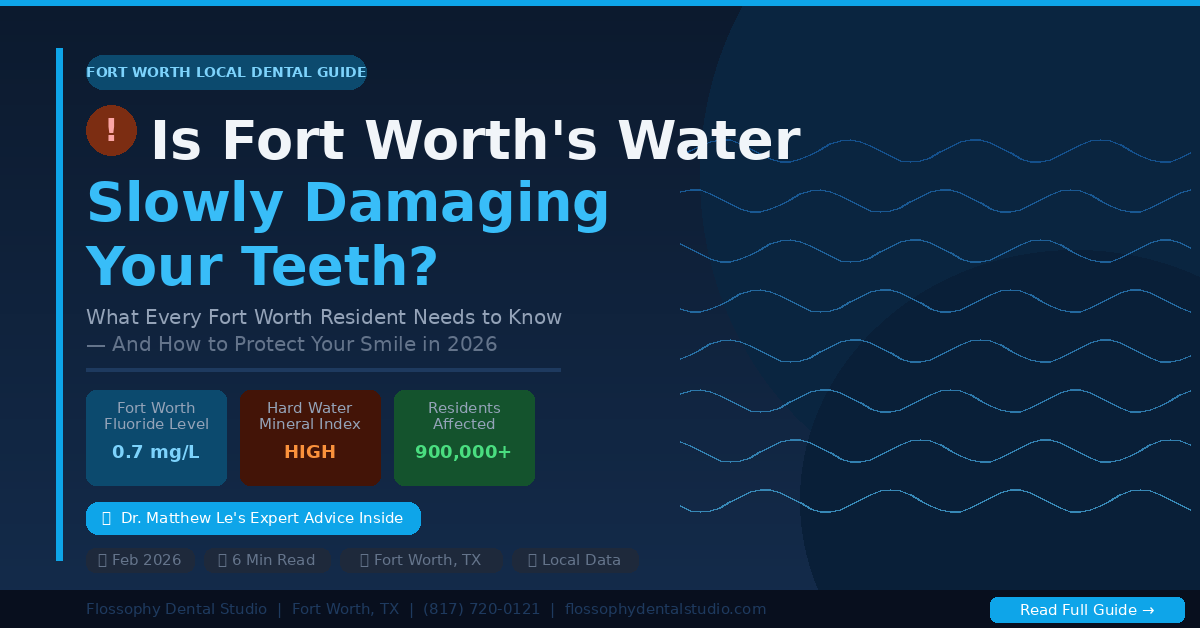
Is Fort Worth’s Water Slowly Damaging Your Teeth? What Every Local Needs to Know
Fort Worth’s tap water contains minerals and fluoride levels that directly affect your teeth — here’s what our Fort Worth dentist wants you to know.
📋 In This Article
- What’s Actually in Fort Worth’s Tap Water?
- How Hard Water Silently Harms Your Teeth
- Fluoride in Fort Worth Water — Too Much or Too Little?
- Warning Signs Your Water Is Affecting Your Smile
- 7 Simple Ways to Protect Your Teeth in Fort Worth
- When to See a Fort Worth Dentist About Water Damage
- How Flossophy Dental Studio Helps Fort Worth Families
Every morning, thousands of Fort Worth residents brush their teeth with local tap water, make their coffee with it, and give it to their kids without a second thought. But here is something most people never consider — the water flowing through Fort Worth’s pipes contains specific minerals, chemicals, and fluoride levels that can have a real, measurable impact on your teeth and gums over months and years.
This is not a scare story. Fort Worth’s water is safe to drink. But as a dentist in Fort Worth, TX, Dr. Matthew Le and the team at Flossophy Dental Studio regularly see patients whose dental issues are directly connected to the water they use every day — and most of them have no idea.
In this guide, we break down exactly what is in Fort Worth’s water, how it can affect your oral health, and the practical steps Fort Worth families can take right now to protect their smiles.
💧 Fort Worth Water Source: Fort Worth gets its water from Eagle Mountain Lake, Lake Bridgeport, and the Trinity River Watershed — all treated at the Rolling Hills Water Treatment Plant. The water is classified as moderately hard to hard, which has specific effects on teeth and enamel.
1. What’s Actually in Fort Worth’s Tap Water?
Most Fort Worth residents assume tap water is just “water.” In reality, municipal water contains a carefully managed mixture of minerals, chemicals, and additives — each of which interacts with your oral health in different ways.
Key Minerals Found in Fort Worth Water
According to Fort Worth’s annual water quality reports, the city’s water supply contains the following elements at measurable levels:
| Mineral / Chemical | Typical Level | Effect on Teeth | Status |
|---|---|---|---|
| Fluoride | 0.7 mg/L | Strengthens enamel at correct dose; can cause fluorosis at high levels | Optimal Range |
| Calcium | Moderate-High | Builds strong enamel; excess causes tartar buildup | Monitor |
| Magnesium | Moderate | Supports bone and tooth density | Beneficial |
| Chlorine | Up to 4 mg/L | Can dry out mouth; reduces saliva; increases cavity risk | Watch |
| Total Hardness | High (150–200 mg/L) | Accelerates tartar and calculus buildup on teeth | Concern |
| pH Level | 7.4 – 8.0 | Slightly alkaline — generally good for enamel | Good |
Hard
Fort Worth Water Classification
0.7 mg/L
Fluoride Level (EPA Optimal)
900K+
Fort Worth Residents Exposed Daily
2. How Hard Water Silently Harms Your Teeth
The biggest water-related dental concern for Fort Worth residents is not fluoride — it is hard water. Fort Worth’s water is classified as hard because of its high mineral content, particularly calcium and magnesium. While these minerals are not harmful to your overall health, they create a specific dental problem that builds up slowly over years.
The Tartar Connection
When hard water mingles with the natural bacteria and saliva in your mouth, the dissolved calcium minerals do not just rinse away. They bond to the surfaces of your teeth — especially along the gumline and between teeth — and gradually harden into dental tartar (also called calculus). This process happens to everyone, but it happens faster and more aggressively in areas with hard water like Fort Worth.
⚠️ Important: Once tartar hardens on your teeth, no amount of brushing or flossing at home will remove it. Only a professional dental cleaning performed by your Fort Worth dentist can safely eliminate hardened tartar from tooth surfaces.
What Happens If Tartar Is Left Untreated
- Gum disease (gingivitis then periodontitis) — tartar irritates gums causing inflammation and bleeding
- Bone loss — advanced gum disease destroys the bone holding your teeth in place
- Tooth decay — tartar creates sheltered spots where cavity-causing bacteria thrive
- Persistent bad breath — bacteria trapped under tartar produce odor-causing compounds
- Tooth loss — the eventual result of untreated advanced gum disease
We see this pattern constantly at our Fort Worth dental office. A patient comes in after skipping cleanings for 18 months, and they have significant tartar buildup — not because they brush badly, but because Fort Worth’s hard water accelerates the process. More frequent cleanings are often the single best intervention for Fort Worth residents.
— Dr. Matthew Le, Flossophy Dental Studio, Fort Worth TX
Hard Water and Your Kids’ Teeth
Children are especially vulnerable to hard water’s effects because their teeth are still developing. The mineral deposits from hard water can interfere with how enamel forms on baby and permanent teeth alike. Fort Worth families with young children should pay particular attention to their kids’ dental cleaning schedule — typically every 6 months at minimum, and sometimes more frequently depending on how quickly tartar forms.
If your child attends school near the Cultural District, Stockyards area, or anywhere in north Fort Worth, they are drinking hard water throughout the day. This makes regular visits to a family dentist in Fort Worth even more important.
3. Fluoride in Fort Worth Water — Too Much or Too Little?
Fluoride is the most well-known additive in municipal water supplies, and Fort Worth — like most major Texas cities — adds fluoride to its water at the EPA-recommended level of 0.7 milligrams per liter (mg/L). This is actually good news for your teeth, with some important nuances to understand.
The Benefits of Fort Worth’s Fluoride Level
- Fluoride at 0.7 mg/L actively strengthens tooth enamel by a process called remineralization
- Regular exposure to fluoridated water has been shown to reduce childhood cavities by up to 25%
- Adults benefit too — fluoride helps reverse early-stage enamel erosion before it becomes a cavity
- Fort Worth’s fluoride level sits right at the optimal therapeutic range recommended by the CDC
The Fluoride Concern — Dental Fluorosis
While Fort Worth’s fluoride levels are within safe limits, there is one condition that Fort Worth parents of young children should be aware of: dental fluorosis. This occurs when children under age 8 consume too much fluoride while their permanent teeth are still forming beneath the gums.
🚨 Watch out for: If your child already drinks fluoridated tap water, check that their toothpaste is age-appropriate (children under 3 should use a rice-grain amount of fluoride toothpaste, ages 3–6 a pea-sized amount). Using adult-sized fluoride toothpaste on top of fluoridated water increases fluorosis risk.
Mild fluorosis typically shows up as faint white streaks on the teeth — cosmetically noticeable but not harmful to dental health. Severe fluorosis is rare at Fort Worth’s water fluoride levels but can cause pitting and brown staining. If you notice these signs on your child’s teeth, speak with your Fort Worth dentist about appropriate fluoride intake for your child’s age and weight.
Should You Use a Water Filter?
Many Fort Worth residents ask whether they should filter their water to remove fluoride. Our honest answer: for most adults and children over 8, there is no dental reason to filter out fluoride — it is actually protecting your teeth. However, if you have very young children or specific health concerns, reverse osmosis filters do remove fluoride and may be appropriate in your situation. Discuss this with both your doctor and your Fort Worth dentist.
💡 Dr. Le’s Tip
The best fluoride source for most Fort Worth residents is their tap water — it delivers low, steady fluoride exposure throughout the day, which is more effective for enamel protection than drinking bottled water and only getting fluoride from toothpaste twice daily.
4. Warning Signs Your Water Is Affecting Your Smile
Because water-related dental damage happens gradually, many Fort Worth residents do not notice it until the damage is well established. Here are the specific warning signs to watch for:
Signs of Hard Water Damage
- Yellow or brown buildup near your gumline — this is hardened tartar from mineral deposits
- Teeth feel rough or gritty even right after brushing — early tartar accumulation
- Gums bleed when you brush or floss — a sign of tartar-triggered gum inflammation
- Persistent bad breath despite brushing — bacteria trapped under tartar buildup
- White chalky spots on teeth — mineral deposits, especially common near the waterline
- Increased sensitivity to hot and cold — can indicate enamel erosion or early gum recession
Signs of Chlorine-Related Dry Mouth
Fort Worth’s water contains chlorine for disinfection — safe to drink, but chlorine can subtly reduce saliva production over time. Saliva is your mouth’s natural defense against decay, so even mild dry mouth from chlorine exposure has dental consequences:
- Mouth feels dry even after drinking water
- Increased cavities despite good brushing habits
- Difficulty chewing dry foods
- Sticky or thick saliva
📌 Fort Worth specific note: Residents living near Alliance, Fossil Creek, and Woodland Springs areas often report harder water at the tap compared to central Fort Worth — meaning tartar buildup can be even more aggressive in these neighborhoods. If you live in north Fort Worth, consider increasing your dental cleaning frequency to every 4 months instead of every 6.
5. 7 Simple Ways to Protect Your Teeth in Fort Worth
The good news is that Fort Worth’s water-related dental effects are entirely manageable with the right habits. Here is exactly what Dr. Le recommends for Fort Worth residents:
1
Schedule Cleanings Every 4–6 Months (Not Just Annually)
Given Fort Worth’s hard water, waiting a full year between cleanings allows significant tartar buildup. Most Fort Worth residents benefit from cleanings every 4–6 months. Our dental cleaning service at Flossophy Dental Studio removes all tartar buildup safely and completely.
2
Use an Electric Toothbrush with a Tartar-Control Toothpaste
Electric toothbrushes remove significantly more plaque than manual brushing — and plaque that is removed before it mineralizes never becomes tartar. Pair with a tartar-control fluoride toothpaste for the best protection against hard water effects.
3
Floss Daily — Without Exceptions
Hard water mineral deposits love to accumulate between teeth where your toothbrush cannot reach. Daily flossing is the only way to disrupt these deposits before they harden. Floss before bed every night — non-negotiable for Fort Worth residents.
4
Rinse with an Antibacterial Mouthwash
An alcohol-free antibacterial mouthwash reduces the bacteria that react with minerals to form tartar. Use it at night after brushing and flossing for maximum effect.
5
Stay Hydrated Throughout the Day with Fort Worth Tap Water
Regularly sipping Fort Worth’s fluoridated tap water throughout the day helps — it rinses away food debris, delivers steady fluoride to enamel, and stimulates saliva production that neutralizes acids. Do not switch entirely to bottled water, which provides no fluoride benefit.
6
Consider a Water Softener for Your Home
If you live in a particularly hard water area of Fort Worth (north Fort Worth, Alliance, Fossil Creek), a home water softener can reduce calcium and magnesium levels before water reaches your tap. This meaningfully slows tartar formation for the whole family.
7
Get a Personalized Assessment from Your Fort Worth Dentist
Everyone’s teeth respond differently to local water conditions. The most effective protection plan is one tailored specifically to your mouth. At Flossophy Dental Studio in Fort Worth, we assess each patient’s individual tartar formation rate and build a custom preventive schedule around it.
6. When to See a Fort Worth Dentist About Water Damage
Many Fort Worth residents put off dental visits because they “feel fine” and assume their teeth are okay. But water-related dental damage is largely painless until it reaches an advanced stage. By the time you feel pain or see obvious discoloration, the underlying damage is often significant — and far more expensive to treat.
See Your Fort Worth Dentist Immediately If You Notice:
- Visible brown, yellow, or black buildup at or below the gumline
- Gums that bleed regularly when you brush or floss
- Any tooth sensitivity that has developed or worsened recently
- White spots or unusual discoloration on your teeth (especially on children)
- Loose teeth or teeth that feel different when you bite down
- Persistent bad breath that does not go away after brushing
- Gums that look like they are pulling away from your teeth
✅ The good news: When caught early, virtually all water-related dental damage is treatable. A professional dental cleaning, periodontal treatment, or laser gum treatment at our Fort Worth office can reverse early gum disease, remove all tartar buildup, and restore your gum health before permanent damage sets in.
What About Children in Fort Worth Schools?
Fort Worth ISD schools serve Fort Worth tap water throughout the school day, meaning continuous hard water mineral exposure from morning through afternoon. We recommend that Fort Worth parents schedule their children’s dental checkups every 6 months minimum, and ask their Fort Worth dentist to assess their child’s individual tartar formation rate at each visit.
7. How Flossophy Dental Studio Helps Fort Worth Families
At Flossophy Dental Studio, we have built our Fort Worth dental practice around understanding exactly what our local community needs — and Fort Worth’s hard water is something we factor into every patient’s care plan from day one.
Our Fort Worth-Specific Approach to Preventive Care
- Tartar assessment at every visit — we measure how quickly each patient forms tartar and customize their cleaning schedule accordingly
- Fluoride treatments available — professional fluoride application for children and adults who need extra enamel protection
- Periodontal screenings — we check gum health at every appointment to catch early gum disease before it progresses
- Patient education — we explain exactly what we find in your mouth and why, so you understand your own oral health
- Laser gum treatment — for patients with existing gum disease, our laser gum treatment offers a minimally invasive path to recovery
- Flexible scheduling — Monday evening appointments until 7PM and early Friday hours from 7:30AM for busy Fort Worth families
New Patient Special for Fort Worth Residents
If it has been a while since your last dental cleaning — or if you have never had a Fort Worth dentist assess your water-related dental risk — now is the perfect time to start. New patients receive our $99 New Patient Special which includes a comprehensive exam, digital X-rays, and a basic cleaning.