$29 Emergency Exam - Walk-Ins Welcome - Same-Day Dental Appointments Available


Here’s something that comes up more often than you’d think in dental appointments: a patient doing everything they believe is right — brushing twice a day, avoiding obvious sugar bombs, showing up for cleanings — and still ending up with enamel erosion, gum recession, or cavities that seem to appear out of nowhere.
The frustrating truth is that some of the most damaging dental habits don’t look like bad habits at all. They look like diligence. They look like common sense. They’ve been passed down through families, reinforced by toothpaste commercials, or quietly normalized because pretty much everyone around you does the same thing.
Fort Worth is a community that takes care of itself — but when it comes to these five specific habits, taking care of yourself might actually mean changing what you thought was already working. Dr. Matthew Le and the team at Flossophy Dental Studio see the consequences of these habits regularly, and the goal of this blog is simple: catch them before the damage adds up any further.
Let’s get into it.
The 5 Dental Habits That Are Quietly Damaging Fort Worth Smiles
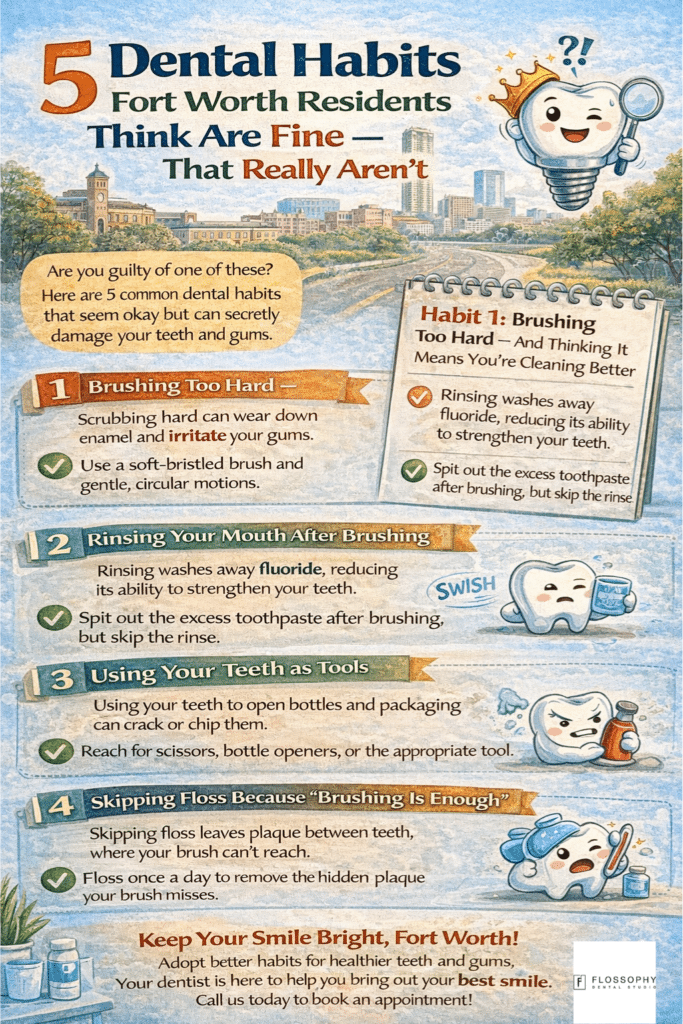
Habit 1: Brushing Too Hard — And Thinking It Means You’re Cleaning Better
This is probably the single most widespread dental misconception in Fort Worth and everywhere else. The logic makes intuitive sense: more pressure equals more dental cleaning power, right? If you scrub a pan harder, it gets cleaner. Why wouldn’t the same apply to teeth?
Because teeth aren’t pans. And enamel — the hard outer layer that protects your teeth — doesn’t grow back once it’s gone.
Aggressive brushing with hard pressure, especially combined with a medium or firm-bristled toothbrush, gradually wears down enamel over time. It also causes gum recession, where the gum tissue pulls away from the base of the tooth and exposes the more sensitive root surface underneath. Receded gums don’t grow back either.
The most effective brushing technique uses light pressure — genuinely light, like you’re brushing something delicate — with a soft-bristled toothbrush held at a 45-degree angle to the gumline, using small circular motions rather than aggressive back-and-forth scrubbing. Two minutes, twice a day. That’s it. The bristles do the work; your arm strength is counterproductive.
If your toothbrush bristles are visibly splayed and flattened after just a couple of weeks, that’s a sign you’re brushing with way too much force.
Habit 2: Rinsing Your Mouth After Brushing
This one genuinely surprises people every single time. Rinsing your mouth with water immediately after brushing — which feels like the natural, logical thing to do — actually undermines one of the most important benefits of brushing in the first place.
Here’s why. Fluoride toothpaste works by leaving a protective film on your tooth surfaces after brushing. That film continues remineralizing and strengthening enamel for a period of time after you put your toothbrush down. When you rinse immediately with water, you wash that film away before it has any meaningful chance to do its job.
The recommendation from dental professionals is to spit out the excess toothpaste after brushing — but don’t rinse. It takes some getting used to, especially if you’ve been rinsing your whole life. But making this one change meaningfully increases the fluoride protection your brushing actually delivers.
If you use mouthwash, use it at a completely separate time — after lunch, for example — rather than immediately after brushing. That way both the toothpaste and the mouthwash get full, uninterrupted contact time with your teeth.
Habit 3: Using Your Teeth as Tools
Fort Worth residents are resourceful, hard-working people. And resourceful people use what they have on hand — including their teeth — to tear open packaging, crack open bottle caps, bite through tags, hold things when their hands are full, or rip off pieces of tape when scissors aren’t nearby.
Every single one of these actions puts your teeth at risk of chipping, cracking, or fracturing — especially the front teeth, which aren’t designed to handle lateral or twisting forces. Teeth are built to bite and chew food in a vertical direction. The moment you introduce sideways pressure, tearing force, or impact against a hard surface, you’re asking them to do something they simply aren’t engineered for.
The damage doesn’t always happen dramatically. Sometimes it’s a hairline crack that doesn’t hurt initially but deepens over time and eventually reaches the nerve. Sometimes it’s a chip that catches the lip or tongue for months before anyone addresses it. And sometimes it’s a full fracture at the worst possible moment.
Keep a bottle opener in your kitchen and scissors in your bag. Your teeth will last considerably longer for it.
Habit 4: Skipping Floss Because “Brushing Is Enough”
This one is Fort Worth’s most popular dental shortcut, and it’s easy to understand why. Flossing is fiddly, it takes extra time, and brushing feels thorough enough. The toothbrush covers the whole tooth, right?
It covers about 60% of each tooth surface. The other 40% — the sides of the teeth, the spaces between them, the area right at the gumline where teeth contact each other — is completely inaccessible to a toothbrush. That’s not a design flaw in toothbrushes. It’s just physics. Bristles can’t get into tight interproximal spaces.
Those spaces are exactly where cavities most commonly develop. They’re also where plaque accumulates and hardens into tartar, which is the primary driver of gum disease. Skipping floss doesn’t mean you’re doing 90% of the work — it means you’re leaving the areas most vulnerable to decay and disease entirely unaddressed every single day.
One minute of flossing once a day, reaching all the way down to the gumline and curving around each tooth rather than just snapping the floss between them, addresses the gap that brushing simply cannot reach. If traditional floss feels difficult, floss picks, water flossers, or interdental brushes all do an effective job and are easier to maintain as daily habits.
Habit 5: Waiting Until Something Hurts to See the Dentist
Of all five habits on this list, this is the one with the most serious long-term consequences — and it’s also the most deeply embedded in Fort Worth’s culture of pushing through and handling things when they become a real problem.
The fundamental issue with this approach is that dental problems rarely hurt until they’ve already progressed significantly. A cavity forming between teeth causes no pain until it reaches the inner pulp of the tooth, at which point a simple filling has become a root canal. Gum disease destroys bone and gum tissue for years before it causes noticeable discomfort. An oral cancer lesion developing on the tongue or cheek can go completely unnoticed without a professional screening.
Pain is a very late indicator in dentistry. By the time something hurts enough to push you into a dental chair, the treatment needed is almost always more extensive, more invasive, and more expensive than it would have been if the problem had been caught six or twelve months earlier at a routine checkup.
Twice-yearly cleanings and exams aren’t about maintaining a habit for the sake of it. They exist because professional eyes, X-rays, and periodontal measurements catch problems in their early, manageable stages — before they cross the threshold into pain and become the kind of news nobody wants to receive.
What Good Dental Habits Actually Look Like
The good news about all five of the habits above is that none of them require dramatic lifestyle changes to fix. Lightening your brushing pressure, skipping the post-brush rinse, keeping scissors within reach, flossing once a day, and booking two appointments a year — these are small adjustments that compound into dramatically better long-term dental health.
As your trusted general dentist Fort Worth community relies on Flossophy Dental Studio is here to help you identify which habits might be quietly working against you — and to build a care plan that actually fits your life, your schedule, and your smile goals. Every patient who walks through our door gets an honest assessment, not a lecture. Just practical guidance from people who genuinely want your teeth to last a lifetime.
If it’s been a while since your last checkup, or if any of the five habits above hit a little too close to home, now is the right time to book an appointment. Fort Worth smiles are worth protecting — and protecting them starts with what you do every single day.
Frequently Asked Questions
1. How do I know if I’m brushing too hard if it feels normal to me?
The most reliable indicator is your toothbrush itself. If the bristles are visibly splayed, bent, or flattened before the three-month replacement mark, you’re applying too much pressure.
2. I’ve been skipping floss for years and haven’t had a cavity between my teeth — does that mean I’m fine?
Not necessarily. Cavities between teeth are often invisible on visual inspection and only show up on X-rays. It’s also worth noting that skipping floss contributes to gum disease buildup that may not manifest as a cavity but is still causing progressive damage to gum tissue and bone. A checkup at Flossophy Dental Studio will give you a clear picture of what’s actually happening in those spaces.
3. How often should Fort Worth residents really be seeing the dentist?
Twice a year is the standard recommendation for most healthy adults, and it holds up well for the majority of patients. However, individuals with a history of gum disease, a higher cavity risk, certain systemic conditions like diabetes, or active orthodontic treatment may benefit from visits every three to four months.
4. My kids brush their teeth every morning — is that enough?
Twice daily is the recommendation for children just as it is for adults. If your children are only brushing once a day, adding an evening brush before bed is particularly important — overnight is when bacteria are most active and saliva flow is lowest, making teeth more vulnerable to acid attack.